I grew up in Massachusetts. As a child, my understanding of history was Massachusetts-centric. The Pilgrims. The Salem Witch Trials. The Boston Tea Party. The Battles of Lexington and Concord. I had one World History class in high school. I retained little beyond Martin Luther’s 95 Theses, posted in 1517.
My understanding of the world broadened in adulthood, yet those early themes of migration, injustice, and revolution still shape my interest in history.
All my ancestors arrived in the United States from Europe or Canada between 1840 and 1890. The Canadian side came from Quebec to Maine; the Québécois branch had originally migrated from France in the 1600s. During recent travels to Prince Edward Island and Nova Scotia, I learned about the French explorers and settlers who shaped that region.
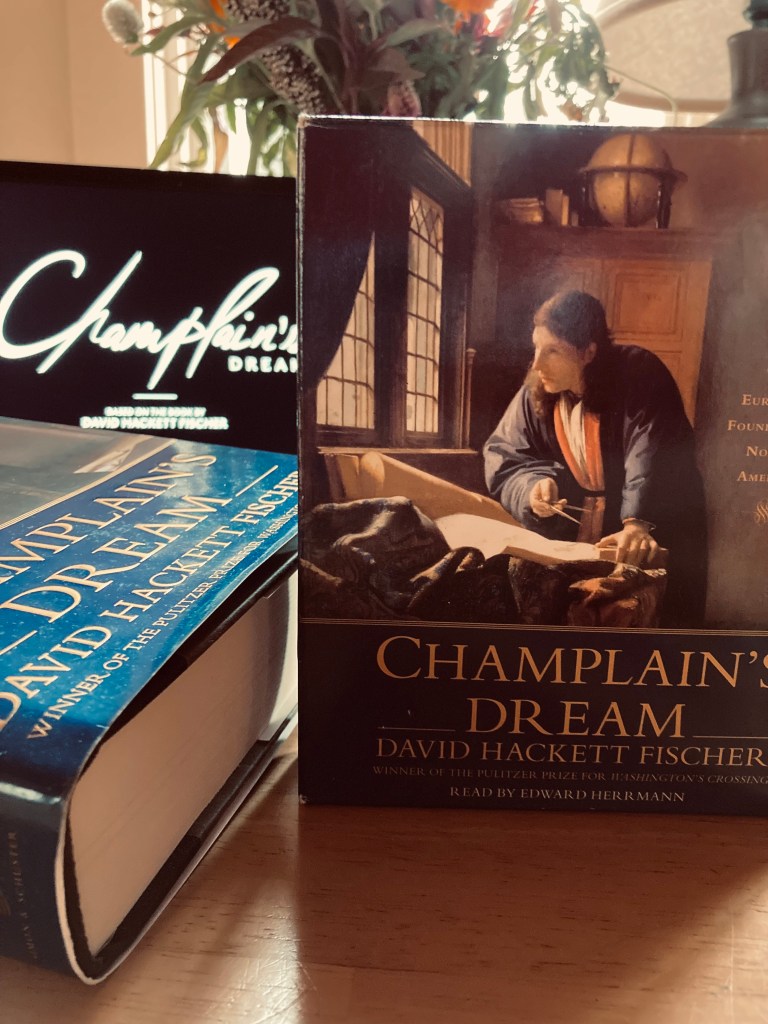
A visit to Port-Royal National Historical Site sparked a renewed interest in Samuel de Champlain. Years ago, I had purchased this book at a used bookstore in Brattleboro, VT:
Fischer, David Hackett (2008). Champlain’s Dream: the European Founding of North America. New York: Simon & Schuster. ISBN 9781416593324.
At over 800 pages, the book overwhelmed me, and I put it aside. After visiting Port-Royal, I borrowed the abridged audiobook version from my local library. The storytelling quality was the charm. I listened while driving—my attention drifted at times—but the narrative rekindled my interest in returning to the full book.
Since listening to the audiobook, I’ve watched several videos featuring Fischer discussing his research methods and findings. All three modes—visiting the site, listening to the audiobook, and watching the author speak—are helping me digest the dense history of Champlain’s journeys and the early French settlements of Nova Scotia and Quebec.
I plan to return to the book and give myself time to absorb its deeper descriptions of the period.
 Tracing North