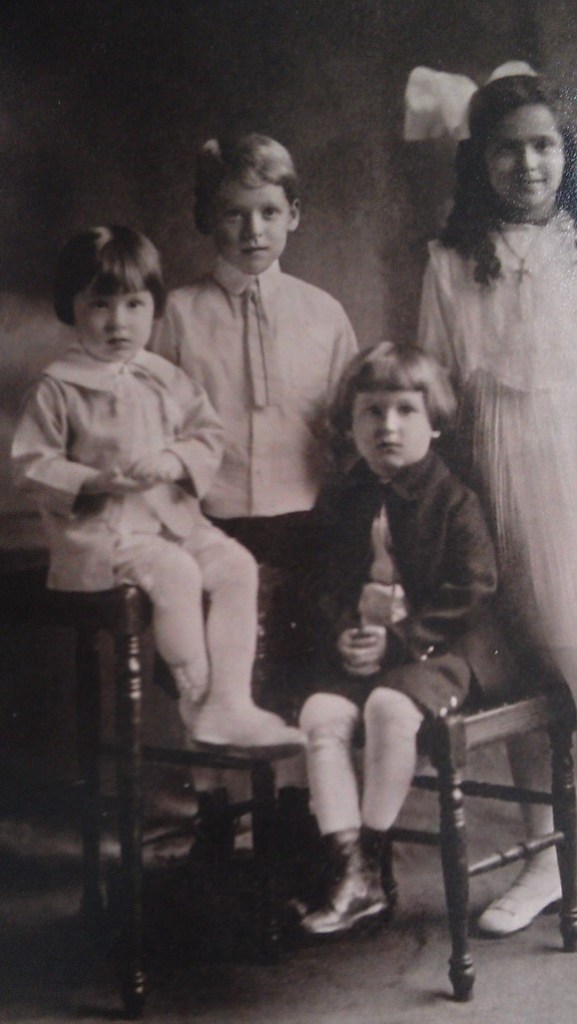
Not pictured: James (infant death), and Frederick (not yet born).
My paternal great-grandmother, Bertha Margaret Rau, was born on the Lower East Side of Manhattan on February 11, 1885. I do not have a photograph of Bertha herself, so I am sharing a photograph of her children.
When Bertha was born, East 2nd Street was part of a dense immigrant neighborhood known as Kleindeutschland—“Little Germany.” It was one of the largest German‑speaking communities in the world outside Europe, as I learned from this article from the Lower East Side Preservation Initiative.
Bertha’s parents, George and Fanny Rau, were married in 1876 in Karlsruhe, Germany. They had at least one child, Elise, before emigrating to the United States. I am still digging to learn more about my German ancestors, but chances are they moved from hardship in Germany into a different kind of hardship in New York.
“When they walked off their ships, hundreds of thousands of men, women and children stayed in New York and had to live in apartments that were cramped, dark, and impossibly small—in buildings that were decaying firetraps, with substandard or broken plumbing and conditions not fit for a human being. Much that they found on the Lower East Side and northward is documented in records, government agency reports and graphic photos in the City’s Municipal Archives and Library. These include Jacob Riis’ ground-breaking book, How the Other Half Lives.” ~ The Early Tenements of New York–Dark, Dank, and Dangerous
In 1885, most babies in German immigrant neighborhoods were delivered by midwives, or Hebammen in German. For German Catholic families, such as my ancestors, a priest might be called to perform an emergency baptism if a newborn seemed weak or unlikely to survive.
By the late 19th century, male physicians were beginning to provide obstetrical care. The neighboring German Dispensary offered free medical treatment to German immigrants. Philanthropists Oswald and Anna Ottendorfer—German immigrants themselves— financed the clinic and the German-English library located alongside.
Bertha Margaret Rau left New York with her father and some of her siblings after the death of her mother. She worked in a carpet maker in Boston, Massachusetts. There she met and married Michael Gilfeather. Bertha had six children in 12 years. In 1908, her baby James died of pneumonia when he was 6 months old.
Bertha died on August 9, 1956, at the age of 71, and is buried in Roslindale, Massachusetts.
To my father’s father’s mother–because you endured, I am here. I did not know your voice, your dreams, or your fears, yet I know that you lived.
 Tracing North