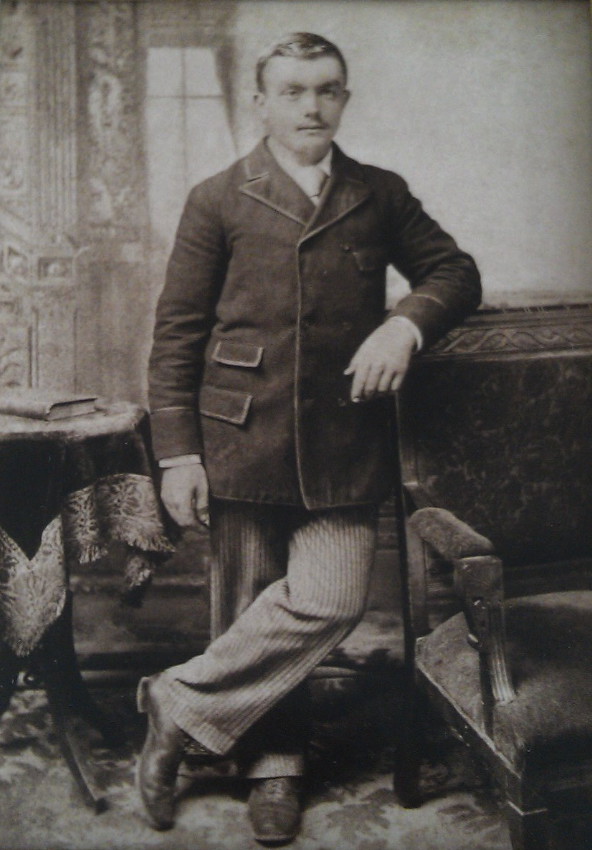
My paternal great-grandfather, Peter Hansen Burkhardt, was born on April 26, 1873 in Dybbøl, a small village in what was then the Prussian Province of Schleswig-Holstein. For those of us tracing family lines in this part of Europe, nationality is not straightforward. Dybbøl was Danish since the Viking Age. After the Second Schleswig War in 1864, the village and surrounding area came under Prussian control. When Peter and his twin sister Anne Marie were born, the region remained linguistically and culturally Danish, even as it became part of the German Empire (a federated state lead by Prussia) in 1871. After World War I, Dybbøl was returned to Denmark in the Treaty of Versailles.
In simple terms, the border between Denmark and Germany shifted many times during this era.
Family lore says that Peter went to sea as a young teenager in the late 1880s, joining a merchant ship to avoid conscription into the Prussian army. I learned that Dybbøl was the center of intense battles in the First Schleswig War (1848–1851) and the Second Schleswig War (1864). I understand why Peter and his family would support a decision to avoid serving in an army that defeated their homeland.
An article in the New York Times in 1888 described military training in the Prussian army in this way: “Under ordinary circumstances the German lad steps into the ranks at the age of 20. For three years he serves with the colors, the next four years he is in the reserve, and the following five years he belongs to the Landwehr, another reserve more remote than the first. Of these twelve years the first three are occupied entirely in severe military work.” ~From the blog 19th Century Rhineland
His twin sister, Anne Marie, remained home. In 1897, she married Heinrich Nissen in nearby Sønderborg. I found baptism and burial records that indicate she lost at least three infant children between 1897 and 1909. I believe there were children who survived, since family stories describe letters exchanged between the Nissen and Burkhardt families. I am searching for the records to confirm their lives.
Peter traveled the world before stepping off a ship, in wooden shoes and without a word of English, and opted to stay in Boston. We were told that a young Irishwoman named Mary D’Arcy noticed men teaching him incorrect (or perhaps vulgar?) English and took him under her wing. They later married and raised eight children in Revere, Massachusetts. They lost one baby, Peter, during a cholera outbreak.
Census records trace Peter’s working life over time. In 1900, he is listed as a house painter. By 1910 and 1920, he worked in ice cream manufacturing. In 1920, he is recorded as a homeowner, marking stability in his work and home life. By 1930, he had returned to house painting, and in 1940, he worked for the government as a painter.
Peter died on May 24, 1950, at the age of 77, in Revere, Massachusetts. I do not know where he is buried.
To my father’s mother’s father–because you endured, I am here. I did not know your voice, your dreams, or your fears, yet I know that you lived.


