On the Birth of Peter Hansen Burkhardt

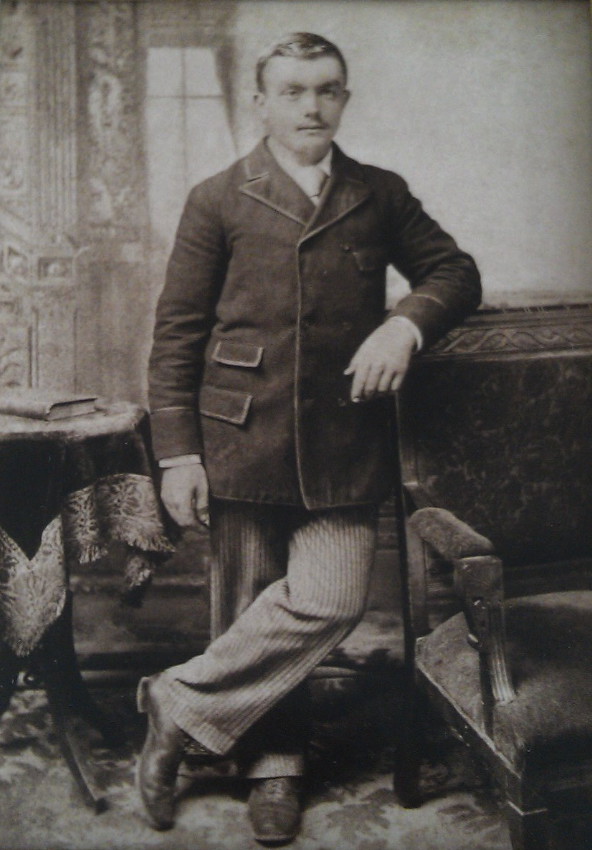
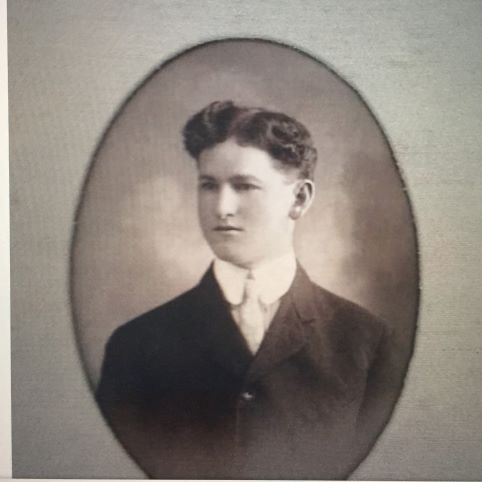
My paternal great-grandfather, Peter Hansen Burkhardt, was born on April 26, 1873 in Dybbøl, a small village in what was then the Prussian Province of Schleswig-Holstein. For those of us tracing family lines in this part of Europe, nationality is not straightforward. Dybbøl was Danish since the Viking Age. After the Second Schleswig War in 1864, the village and surrounding area came under Prussian control. When Peter and his twin sister Anne Marie were born, the region remained linguistically and culturally Danish, even as it became part of the German Empire (a federated state lead by Prussia) in 1871. After World War I, Dybbøl was returned to Denmark in the Treaty of Versailles.

In simple terms, the border between Denmark and Germany shifted many times during this era.

Family lore says that Peter went to sea as a young teenager in the late 1880s, joining a merchant ship to avoid conscription into the Prussian army. I learned that Dybbøl was the center of intense battles in the First Schleswig War (1848–1851) and the Second Schleswig War (1864). I understand why Peter and his family would support a decision to avoid serving in an army that defeated their homeland.

An article in the New York Times in 1888 described military training in the Prussian army in this way: “Under ordinary circumstances the German lad steps into the ranks at the age of 20. For three years he serves with the colors, the next four years he is in the reserve, and the following five years he belongs to the Landwehr, another reserve more remote than the first. Of these twelve years the first three are occupied entirely in severe military work.” ~From the blog 19th Century Rhineland

His twin sister, Anne Marie, remained home. In 1897, she married Heinrich Nissen in nearby Sønderborg. I found baptism and burial records that indicate she lost at least three infant children between 1897 and 1909. I believe there were children who survived, since family stories describe letters exchanged between the Nissen and Burkhardt families. I am searching for the records to confirm their lives.

Peter traveled the world before stepping off a ship, in wooden shoes and without a word of English, and opted to stay in Boston. We were told that a young Irishwoman named Mary D’Arcy noticed men teaching him incorrect (or perhaps vulgar?) English and took him under her wing. They later married and raised eight children in Revere, Massachusetts. They lost one baby, Peter, during a cholera outbreak.

Census records trace Peter’s working life over time. In 1900, he is listed as a house painter. By 1910 and 1920, he worked in ice cream manufacturing. In 1920, he is recorded as a homeowner, marking stability in his work and home life. By 1930, he had returned to house painting, and in 1940, he worked for the government as a painter.

Peter died on May 24, 1950, at the age of 77, in Revere, Massachusetts. I do not know where he is buried.

To my father’s mother’s father–because you endured, I am here. I did not know your voice, your dreams, or your fears, yet I know that you lived.

On the Birth of Lillian Ester Burkhardt

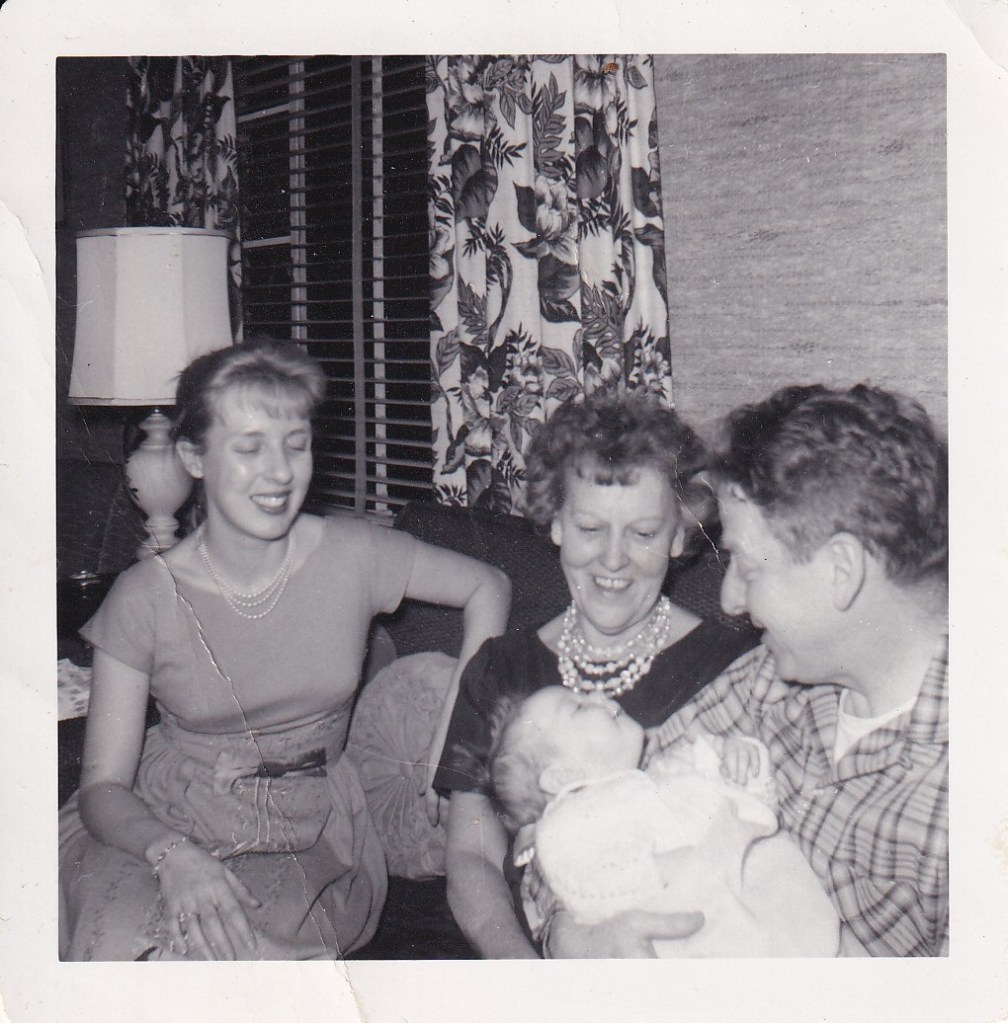
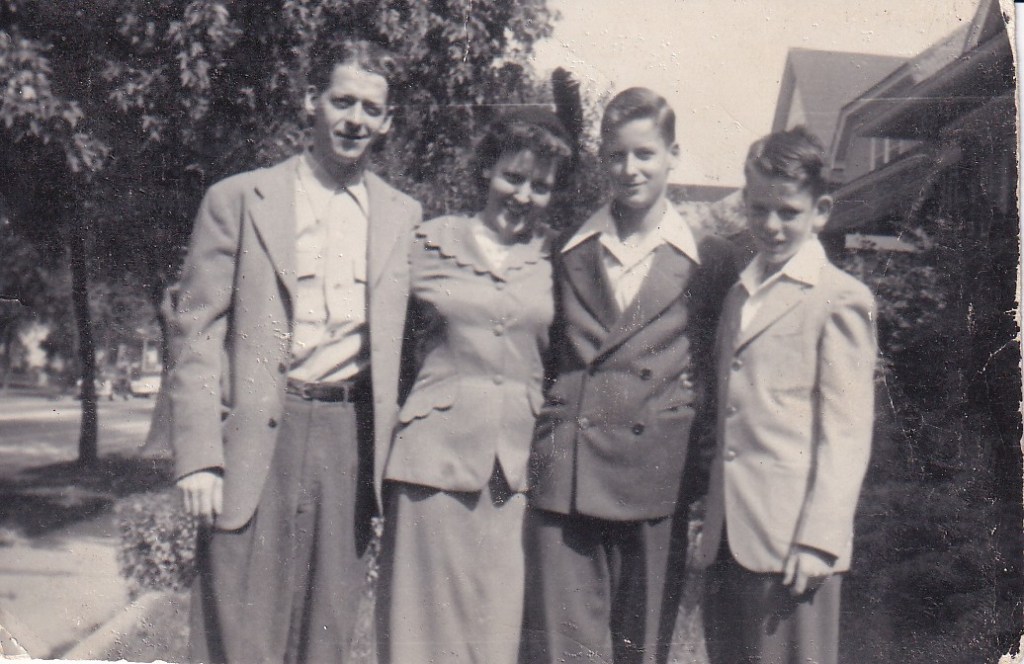
Nana with my grandfather Frank, my uncle “Bud”, and my dad.

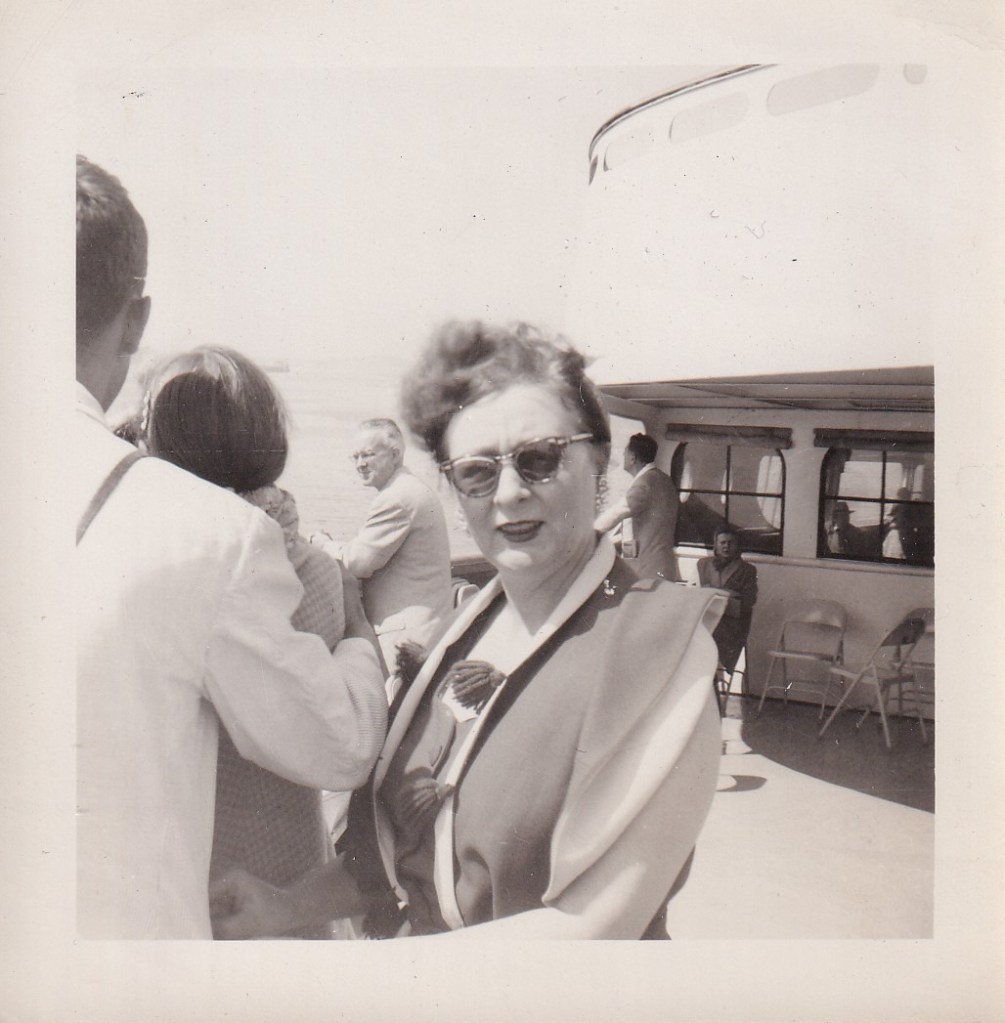
My paternal grandmother, Lillian Ester Burkhardt (known to us as Nana), was born on April 10, 1909, in Winthrop, Massachusetts. She was born the day before Easter and was named after the Easter lily. The youngest daughter of nine children, Lillian was the longest-lived among them. Nana credited her good health to daily walks and mustard.

Lillian’s parents were immigrants from different parts of Europe. Her mother, Mary D’Arcy, came from County Galway in Ireland. Her father, Peter Burkhardt, emigrated from Schleswig-Holstein, Germany’s northernmost region. Peter was born just across the border in Denmark. Mary and Peter met as young immigrants in Boston, Massachusetts.

Mary wanted to raise her children in the Catholic faith, and Peter, who had been raised Lutheran, did not object. Their household reflects the American “melting pot” of nationalities and religions. Mary D’Arcy died when Lillian was seventeen. Lillian spoke fondly of her older sisters, who may have nurtured her during their mother’s illness and death.

By the age of twenty, Lillian was working as a stenographer. She was part of a growing clerical workforce. She likely met her future husband, Francis George Gilfeather, at work. They married on June 24, 1933, and settled in Revere near Lillian’s family. She gave birth to two sons, Frank Jr. (Bud) and Paul. Lillian took great pride in her boys.

Lillian embraced the role of suburban housewife. By 1950, the family had moved to Oak Park, Illinois, part of a broader postwar pattern of families relocating for white-collar work and settling into new suburban communities. Lillian was delighted when the neighbors welcomed her with gifts of canned goods. The joke was that the labels had been removed. Nana would laugh as she recounted opening the cans without knowing what she would be serving for dinner.

I remember Uncle Bud and my dad teasing her about the lunches she packed for them when they were teenagers: a ham sandwich, a cheese sandwich, and a ham-and-cheese sandwich. She laughed at their teasing. To her, this was her way of making sure they were well fed and cared for. Three sandwiches for hungry boys; three different types of sandwiches.

Lillian and Frank returned to Massachusetts when my father Paul was a senior in high school. The 1960s brought significant deaths. Lillian lost four siblings, Frank’s youngest brother, and then her beloved husband Frank. She met those losses with quiet resilience.

Lillian maintained close relationships with her sons and their families, her sisters-in-law, and her nieces and nephews. She remained socially active throughout her life, playing cards and taking excursions with local seniors. She carried forward the same warmth and good humor that had helped her throughout her life.

To my father’s mother—because you endured, I am here. I knew you in the years we shared, and I am still learning about the world that influenced your younger years.

On the Birth of John Baptist Mutty

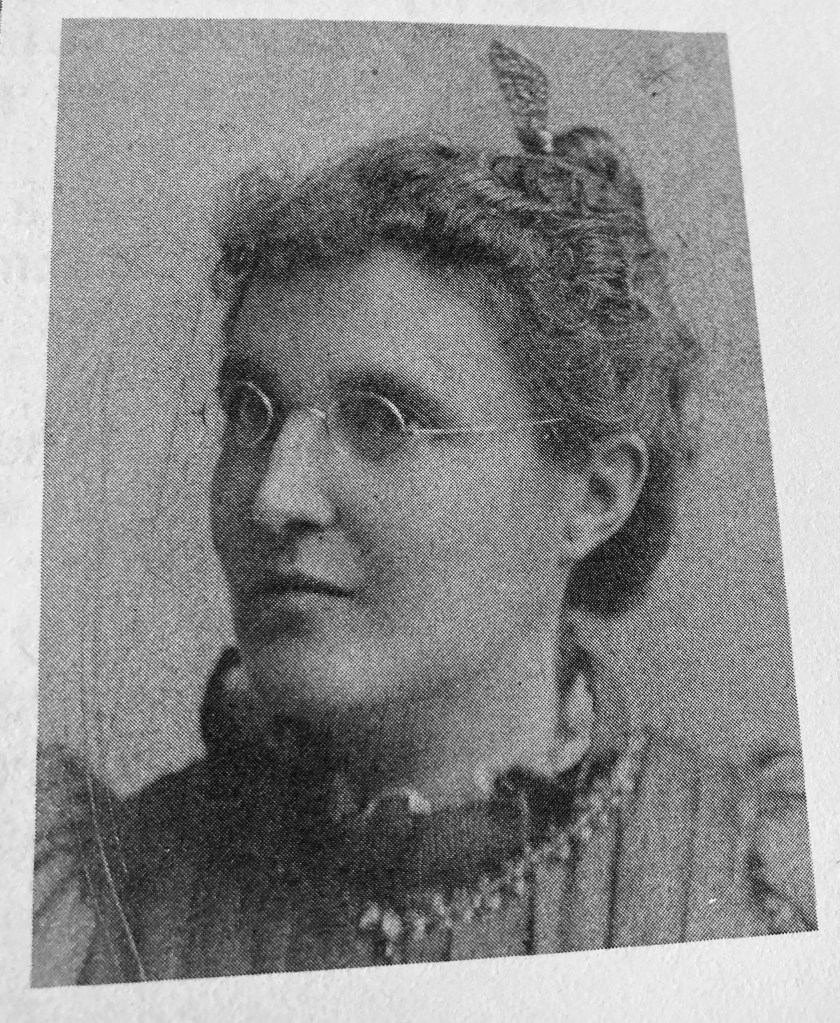
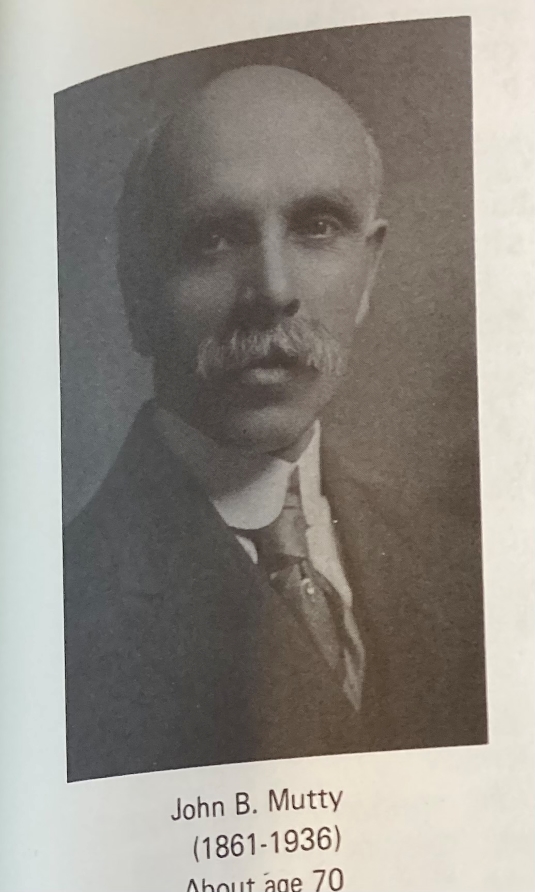
Photo from Dana Pierce, Lineage of the Thibodeau, Mothee-Thibodeau, Mutty family : the ancestry, events, and accomplishments of the Mutty family, 1985.

My maternal great-grandfather, John Baptist Mutty, was born on March 31, 1861 in South Brewer, Maine. This photograph comes from a lineage booklet compiled by Dana Pierce, my first cousin once removed. Known as John B., my great-grandfather was the eldest of twelve children in a French Canadian family rooted in both Québec and Maine.

John B.’s father, John Thibodeau Mutty, was born in Maine to Québécois parents, and his mother, Mary Selena Boulette, emigrated from Québec around the time of her marriage in 1860. Like many French Canadian families in the mid-19th century, they crossed the border in search of steady work. From 1850 to 1930 one million Québécois migrated to the United States. Thousands of Québécois migrants settled in Maine’s river towns, where the lumber industry was booming.

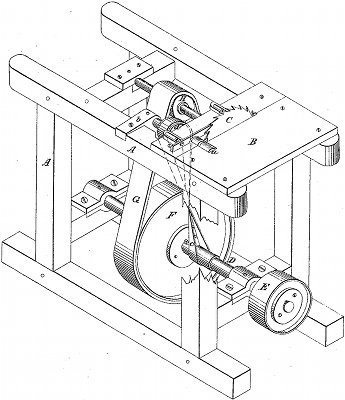
The Mutty family’s livelihood was closely tied to that world. In the 1850 Census, John B.’s father is listed as a millworker; by 1870, he was working as a saw filer—a skilled position responsible for maintaining the large circular saws that powered the mills. In 1866, he was granted a U.S. patent for an improvement in feed rollers to circular saws (Patent No. 52,188).

US Patent: 52,188. Improvement in feed-rollers to circular saws. John Thibodeau Mutty

The spirit of hard work and invention influenced the next generation. In the 1880 Census, nineteen-year-old John B. is listed as a sawmill worker. In 1883, John B. married Estelle Pooler in Bangor, and together they had six children. My grandfather, Lawrence, was the youngest. The family’s work trajectory did not remain tied to the lumber industry. According to Dana’s detailed lineage, John B. shifted to the burgeoning shoe industry when he had young children.

In 1917, John B.’s brother Victor invited him and their brother Louis to join him in Boston, where he had established a successful manufacturing business producing rubberized canvas for automobiles and fabric for player pianos. Thus, several members of the Mutty family settled in Melrose, Massachusetts.

And yet, Maine remained home in a deeper sense. In his lineage booklet, Dana Pierce recalls attending “Grandpa” Mutty’s wake, and then, on the day of the funeral, walking to the railroad tracks near St. Mary’s Grammar School to watch the Bangor Express pass by:

“to pay my last respects as ‘Grandpa’ sped by—and perhaps to wave to my grieving mother who was aboard the train with other members of the family.”

John B. died in Melrose, Massachusetts, on May 26, 1936, at the age of 75. He is buried in Bangor, Maine.

To my mother’s father’s father–because you endured, I am here. I did not know your voice, your dreams, or your fears, yet I know that you lived.

On the Birth of Mary Josephine D’Arcy

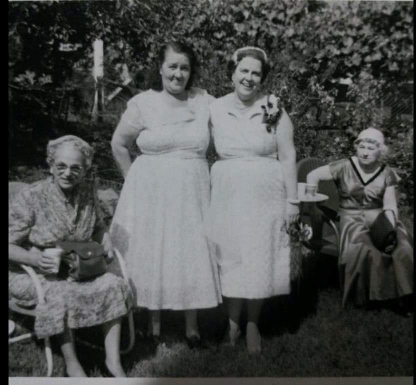
Mary D’Arcy’s daughters (standing), May and Grace.
Identities of the seated women are unknown.

My paternal great-grandmother, Mary Josephine D’Arcy, was born in Oughterard, Ireland on March 5, 1871. I do not have a photograph of Mary herself, so I am sharing a photograph of her two eldest daughters, Mary (“May”) and Grace. They look so loving and joyful.

Nana said that her mother was born in Ireland to French parents. This isn’t exactly true. The D’Arcys are believed to be descended from a French family that arrived in Ireland in the 14th century. One of the 14 Tribes of Galway, the D’Arcys were a merchant family who wielded great power. I am sure that story was told down the generations with great pride.

In this branch of my family tree, my father’s mother’s family, I am confronting multiple spellings of the family name. Mary’s last name was D’Arcy, but I have seen Darcy and Dorsey as variations in vital records and censuses.

According to the Irish Civil Marriage Record, Martin Darcy and Bridget Davin were wed on April 15, 1868. He was 24 and she was 22. They were both laborers in Porridgetown, and their fathers Rodger Darcy and Peter Davin are listed as farmers. Porridgetown is a township of Oughterard.

In the 1871 Civil Birth Registry in County Galway, Ireland, Martin Darcy and Bridget Davin registered their infant daughter Mary (my great-grandmother) as born in Porridgetown. Kate Davin was present at the birth. I am assuming that Kate was a female relative of Bridget’s. Seven years later, Bridget D’Arcy‘s death was recorded in Porridgetown. The cause? Uterine inflammation.

Mary D’Arcy arrived in the United States when she was seventeen, possibly with her older brother Rodger. I do not know where she worked, but I do know that she met Peter Burkhardt in Boston, and they married in Chelsea on September 21, 1893. In the Massachusetts Marriage Registry, Mary’s parents are listed as Martin Dorsey and Bridget Davin.

Mary had nine children in 18 years. Her second born, Peter, died in infancy during a cholera outbreak in 1896. Nana used to recite the names of her siblings: Herbie, Marty, Gracie, May, Carrie, Dorie, (she was the youngest daughter, Lillian) and Alfie.

Mary died on March 16, 1927, at the age of 56, in Revere, Massachusetts. I do not know where she is buried.

To my father’s mother’s mother–because you endured, I am here. I did not know your voice, your dreams, or your fears, yet I know that you lived.

On the Birth of Michael Francis Gilfeather

My paternal great-grandfather, Michael Francis Gilfeather, was born in Roxbury, Massachusetts on February 26, 1886. His father Michael emigrated from County Fermanagh, Ireland in 1859. Michael Sr. worked as a stonemason in Boston. There he met and married Irish immigrant Catherine McGeever. She is listed as his second wife. I do not know the identity of Michael Sr.’s first wife, nor do I know if he had children in his first marriage.

When Michael Jr. was just eleven years old, his father died of tuberculosis. By the 1900 Census, Catherine was a widow, and her three teenaged children — Mary (18), James (16), and Michael (14) — were working as shoemakers.

They were likely employed at the Thomas G. Plant Shoe Factory in nearby Jamaica Plain. Built in the 1890s, the factory was one of New England’s largest shoe manufacturers. The factory offered amenities and benefits intended to foster worker loyalty and discourage union organizing. Yet in 1919, workers at the Plant factory went on strike for nearly eighteen months. I am learning that there was a lot of labor unrest after World War I.

Here is a fascinating lecture on the Thomas G. Plant Shoe Factory from the Jamaica Plain Historical Society that gives us some context.

Michael Jr.’s World War I draft registration card, dated September 12, 1918, lists his employer as the George E. Keith shoe manufacturing plant in East Weymouth. That means it was unlikely that he was involved in the 1919 strike. Census records through 1930 show that Michael Jr., his wife Bertha, and their five children continued to live in Roxbury while he remained employed in shoe factories. This suggests that he may have boarded near his workplace when he worked for George E. Keith.

Michael died on August 20, 1933, at the age of 47, and is buried in Roslindale, Massachusetts.

To my father’s father’s father–because you endured, I am here. I did not know your voice, your dreams, or your fears, yet I know that you lived.

On the Birth of Bertha Margaret Rau

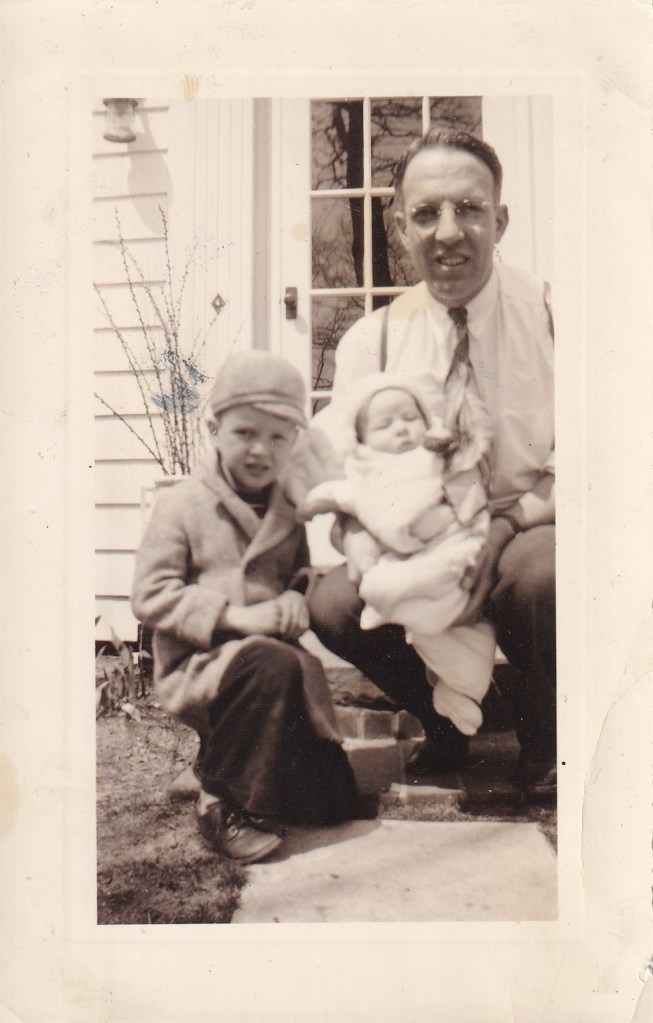
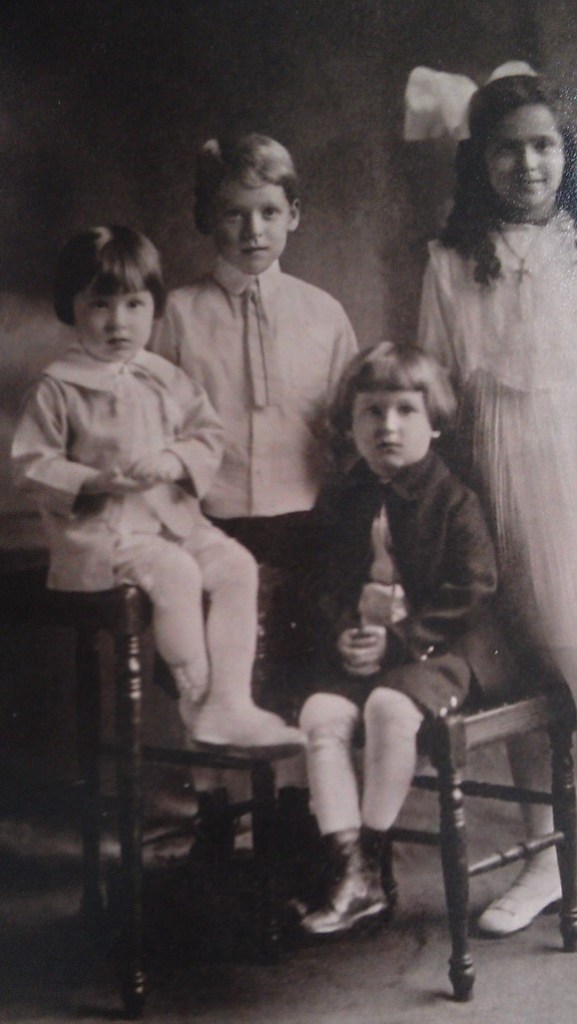
Bertha’s children: George, Francis (my grandfather), John, and Mary.
Not pictured: James (infant death), and Frederick (not yet born).

My paternal great-grandmother, Bertha Margaret Rau, was born on the Lower East Side of Manhattan on February 11, 1885. I do not have a photograph of Bertha herself, so I am sharing a photograph of her children.

When Bertha was born, East 2nd Street was part of a dense immigrant neighborhood known as Kleindeutschland—“Little Germany.” It was one of the largest German‑speaking communities in the world outside Europe, as I learned from this article from the Lower East Side Preservation Initiative.

Bertha’s parents, George and Fanny Rau, were married in 1876 in Karlsruhe, Germany. They had at least one child, Elise, before emigrating to the United States. I am still digging to learn more about my German ancestors, but chances are they moved from hardship in Germany into a different kind of hardship in New York.

“When they walked off their ships, hundreds of thousands of men, women and children stayed in New York and had to live in apartments that were cramped, dark, and impossibly small—in buildings that were decaying firetraps, with substandard or broken plumbing and conditions not fit for a human being. Much that they found on the Lower East Side and northward is documented in records, government agency reports and graphic photos in the City’s Municipal Archives and Library. These include Jacob Riis’ ground-breaking book, How the Other Half Lives.” ~ The Early Tenements of New York–Dark, Dank, and Dangerous

In 1885, most babies in German immigrant neighborhoods were delivered by midwives, or Hebammen in German. For German Catholic families, such as my ancestors, a priest might be called to perform an emergency baptism if a newborn seemed weak or unlikely to survive.

By the late 19th century, male physicians were beginning to provide obstetrical care. The neighboring German Dispensary offered free medical treatment to German immigrants. Philanthropists Oswald and Anna Ottendorfer—German immigrants themselves— financed the clinic and the German-English library located alongside.

Bertha Margaret Rau left New York with her father and some of her siblings after the death of her mother. She worked in a carpet maker in Boston, Massachusetts. There she met and married Michael Gilfeather. Bertha had six children in 12 years. In 1908, her baby James died of pneumonia when he was 6 months old.

Bertha died on August 9, 1956, at the age of 71, and is buried in Roslindale, Massachusetts.

To my father’s father’s mother–because you endured, I am here. I did not know your voice, your dreams, or your fears, yet I know that you lived.

On the Birth of Margaret Mary Barry

My maternal great-grandmother, Margaret Mary Barry, was born in Kinsale, Ireland on January 4, 1877. According to the Registrar General of Marriages, Births, and Deaths in Ireland: Fourteenth Annual Report 1877, there were 100 baby girls born in Kinsale between January and March 1877. Two women died in childbirth during the same time period. The report is available at this link.

Sadly, one of those women was my great-great-grandmother Margaret Mary Coleman. She was 18 years old when she died the day after giving birth to her first child.

In 1877, the leading causes of maternal mortality were infection from unsafe birthing practices, excessive bleeding without the benefit of transfusions, and convulsions due to high blood pressure. The registration of Margaret Barry’s (née Coleman) death is available online at this link. The cause is listed as puerperal peritonitis (postpartum infection). Her husband Thomas Barry, a farmer, was present at her death.

My grandmother told us that newborn Margaret was swaddled in her grandmother’s apron and brought home to be raised by relatives until Thomas remarried several years later. The birth registration for my great-grandmother Margaret Mary Barry is available at this link.

Like many young Irish women, Margaret Mary Barry left Ireland to work as a maid in Boston, Massachusetts. She met Cornelius Finbar Deasy in Boston, and they married on August 22, 1901. Margaret and Cornelius returned to Ireland to start their family. They made their immigration journey in the 1910s to settle in Melrose, Massachusetts. Margaret had eight children in 17 years. Her baby Cornelius died during the flu epidemic of 1918.

Margaret died on May 9, 1964, at the age of 87, and is buried in Mattapan, Massachusetts.

To my mother’s mother’s mother–because you endured, I am here. I did not know your voice, your dreams, or your fears, yet I know that you lived.

Un chant de Noël

I discovered parallel texts on my language-learning journey. On one page is your native language (L1); directly opposite is the target language (L2). Reading this way creates a side-by-side experience that supports comprehension as you move through the text. Although parallel texts have their critics, I enjoy them.

Here’s what the TeachVid blog says:

“Much of what is written in support of parallel texts is along the following lines:

They allow users to directly compare the L1 and the L2, which helps promote ‘noticing’.
The ability to compare the way vocab and structures are formed and combined in the L2 with reference to the L1 equivalent promotes this noticing of differences which may not happen if students only had access to the L2 text.

They allow users to access texts beyond their level.
Readers can read an L2 text and have constant recourse to an L1 equivalent so that they can check that they are understanding what they are reading.

Parallel texts can indeed be a powerful tool, if used by motivated language learners who really are using the time with the texts to understand how the L2 works, forming hypotheses and checking and confirming that they understand correctly what is happening with the language.” ~ In Support of Parallel Texts

Critics argue that parallel texts make it too easy to lean on the L1 page for understanding—and I get that. I see the same impulse in my French class at the International Language School. We all breathe a sigh of relief when we slip into English to work through the challenges of L2.

As researcher Andira Abdallah notes in her paper:

“Based on my experience as a second language instructor, it is very hard, if not impossible, to eliminate the first language use during the collaborative work of students in a second language learning environment especially when the majority of these students share the same L1.” ~ Impact of Using Parallel Text Strategy on Teaching Reading to Intermediate II Level Students

Josh, my French teacher, encourages us to read stories that are already familiar to us. While he doesn’t explicitly promote parallel texts, he strongly affirms the underlying principle: knowing the storyline reduces cognitive load, making it easier to engage with and absorb the target language.

Here’s a bit from A Christmas Carol by Charles Dickens. Without access to your L1, can you understand what it says?

“Un chant de Noël, Chapitre 1

Le spectre poussa encore un cri, secoua sa chaîne et tordit ses mains fantastiques. 

<< Vous êtes enchaîné ?  dit Scrooge tremblant ; dites-moi pourquoi.

– Je porte la chaîne que j’ai forgée pendant ma vie, répondit le fantôme. C’est moi qui l’ai faite anneau par anneau, mètre par mètre ; c’est moi qui l’ai suspendue autour de mon corps, librement et ma propre volonté, comme je la porterai toujours de mon plein gré. Est-ce que le modèle vous en paraît étrange ? >>     

Scrooge tremblait de plus en plus. 

<< Ou bien voudriez-vous savoir, poursuivit le spectre, le poids et la longueur du câble énorme qui vous traînez vous-même ? Il était exactement aussi long et aussi pesant que cette chaîne que vous voyez, il y a aujourd’hui sept veilles de Noël. Vous y avez travaillé depuis. C’est une bonne chaîne à présent ! >>    

Scrooge regarda autour de lui sur le plancher, s’attendant à se trouver lui-même entouré de quelque cinquante ou soixante brasses de câbles de fer; mais il ne vit rien.”

Dickens, Charles. A Christmas Carol / Un chant de Noël: Bilingual Classic (English-French Side-by-Side). Odéon Press, [2017]. ISBN: 9781973451723

Making Sense of My AncestryDNA Results

I received my AncestryDNA results last week and I am learning how to interpret what they actually mean. Ancestry.com identifies “Regions” where my DNA most closely matches their genetic reference panels. None of my Regions came as a surprise, but understanding how they arrive at those numbers has been instructive.

As Ancestry.com explains:

“A reference panel is a set of people whose DNA is typical of DNA from a certain place or group. When you take an AncestryDNA® test, we compare your DNA to the DNA in our reference panels to identify your ancestral origins. For example, to determine your ancestral regions, we find the reference panel DNA that’s most similar to each segment of your DNA. Then, we assign your segments to the regions they resemble.” — Ancestry.com

In other words, Ancestry.com assigns my DNA to regions even if my ancestors didn’t live in that exact location. My Quebec assignment, for example, appears because my genetic profile closely matches the modern descendants of the French founders who settled there in the 1600s. That lines up with what I know from my family history.

My report also shows small percentages from England and Norway, even though (as far as I know) none of my ancestors came from those countries. These small percentages simply mean I share slight genetic similarity with the people in those reference panels.

Another important point: we inherit a random mix of DNA from each of our parents. So the heritage I know from family records won’t necessarily line up with the DNA that I randomly received. And my parents inherited a random mix from their parents. I will never get 100% accuracy. There will be missing pieces.

With that in mind, I compared what I know about my family history with what my DNA report showed:

Irish: Four of my great-grandparents were Irish. That makes me 50% Irish. My mother’s grandparents were Irish immigrants, and on my father’s side both his maternal grandmother and paternal grandfather came from Irish families. My DNA shows 57% Irish, specifically from the Munster and Connacht provinces.

Québécois: Two of my maternal great-grandparents were descended from Quebec immigrants. I am 25% Québécois. My DNA shows 16%. From the results-by-parent chart, it appears that I inherited a larger share of my mother’s Irish DNA than her Québécois DNA.

Danish: My father’s maternal grandfather emigrated from Denmark. I am one-eighth, or 12.5% Danish. My DNA shows 11%, which is remarkably close.

German: My father’s paternal grandmother was born to German immigrants. Another one-eighth or 12.5%. My DNA shows 10%, a second close match.

In the end, my DNA results didn’t reveal any big surprises—but the report did add depth to what I already know. The results show which parts of my heritage were passed down to me, and in what proportions, while also pointing to historic communities that my ancestors belong to. It’s a starting point for more research, and a reminder that DNA is one more tool for understanding where we come from.

The photo above shows my teenaged daughters walking through a tunnel in Ireland in August, 2002.

Learning about Champlain

A book, audiobook, and laptop on a table.

I grew up in Massachusetts. As a child, my understanding of history was Massachusetts-centric. The Pilgrims. The Salem Witch Trials. The Boston Tea Party. The Battles of Lexington and Concord. I had one World History class in high school. I retained little beyond Martin Luther’s 95 Theses, posted in 1517.

My understanding of the world broadened in adulthood, yet those early themes of migration, injustice, and revolution still shape my interest in history.

All my ancestors arrived in the United States from Europe or Canada between 1840 and 1890. The Canadian side came from Quebec to Maine; the Québécois branch had originally migrated from France in the 1600s. During recent travels to Prince Edward Island and Nova Scotia, I learned about the French explorers and settlers who shaped that region.

A visit to Port-Royal National Historical Site sparked a renewed interest in Samuel de Champlain. Years ago, I had purchased this book at a used bookstore in Brattleboro, VT:

Fischer, David Hackett (2008). Champlain’s Dream: the European Founding of North America. New York: Simon & Schuster. ISBN 9781416593324.

At over 800 pages, the book overwhelmed me, and I put it aside. After visiting Port-Royal, I borrowed the abridged audiobook version from my local library. The storytelling quality was the charm. I listened while driving—my attention drifted at times—but the narrative rekindled my interest in returning to the full book.

Since listening to the audiobook, I’ve watched several videos featuring Fischer discussing his research methods and findings. All three modes—visiting the site, listening to the audiobook, and watching the author speak—are helping me digest the dense history of Champlain’s journeys and the early French settlements of Nova Scotia and Quebec.

I plan to return to the book and give myself time to absorb its deeper descriptions of the period.